Big O for Memory
Big O can describe memory the same way it describes time: how much extra space does the algorithm need as the input grows?
We count only the extra space — the variables and lists the algorithm creates — not the input itself. This extra space is called auxiliary space.
O(1) space: a fixed number of variables, no matter the input. O(n) space: something new is stored per input element, like a copy or a set of seen values.
O(1) Space
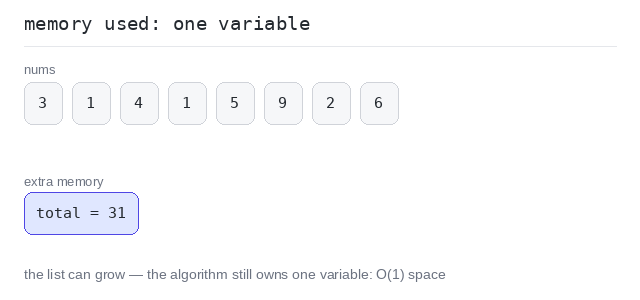
An algorithm that keeps only a few plain variables uses constant space. The list can hold ten elements or ten million — the algorithm itself still owns just its counters.
Summing, finding the maximum, and linear search are all O(n) time but O(1) space: they read a lot and remember almost nothing.
Sum with one variable
The whole algorithm remembers exactly one number, total. Its memory use does not grow with the list: O(1) space.
Output: complete Python program
nums = [3, 1, 4, 1, 5, 9, 2, 6]

# One extra variable, no matter how long the list is.
total = 0
for n in nums:
  total += n

print("sum:", total)
O(n) Space
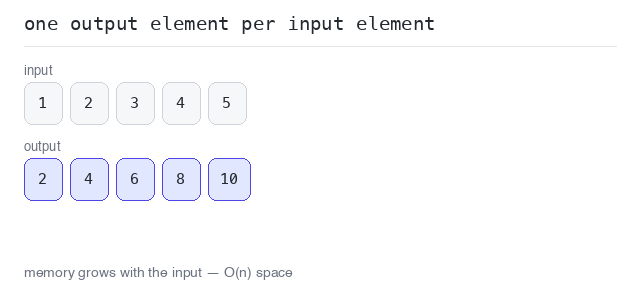
As soon as the algorithm builds something with one entry per input element — a new list, a dictionary — its space is O(n): double the input, double the memory.
That is not bad by itself. It is simply a cost you should notice, because it can be traded.
Build a new list
The output list gets one element for every input element. 5 in, 5 out — memory grows in step with the input: O(n) space.
Output: complete Python program
nums = [1, 2, 3, 4, 5]

# A new list with one element per input element.
doubled = []
for n in nums:
  doubled.append(n * 2)

print("input: ", nums)
print("output:", doubled)
Trading Space for Time
Often you can spend memory to save time. The classic example is Two Sum: find two numbers in a list that add up to a target.
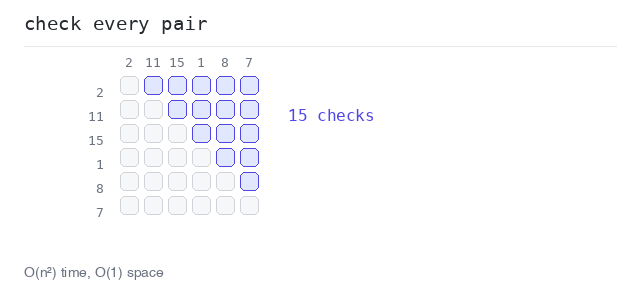
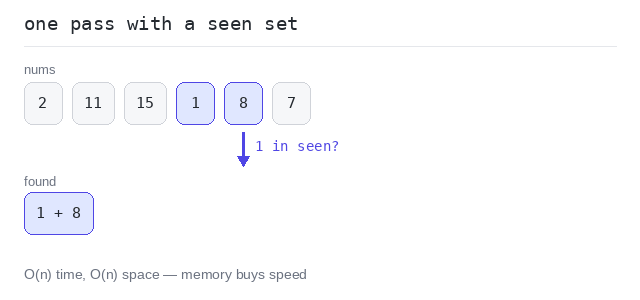
The direct way checks every pair — O(n²) time, O(1) space. The fast way walks the list once and remembers every number it has seen in a set. For each number it asks: "have I already seen target - n?" — O(n) time, O(n) space.
This trade is usually worth it: memory can be added to a machine, time cannot.
Two Sum with two loops
Every pair is checked until a match appears — up to 15 checks for 6 elements, and the count grows with the square of the input. No extra memory is used.
Output: complete Python program
nums = [2, 11, 15, 1, 8, 7]
target = 9
checks = 0

for i in range(len(nums)):
  for j in range(i + 1, len(nums)):
    checks += 1
    if nums[i] + nums[j] == target:
      print("found:", nums[i], "+", nums[j], "after", checks, "checks")

print("total checks:", checks)
Two Sum with a set
One pass, 6 checks. Each number is looked up and stored in the seen set — constant-time work per element. The set is the O(n) memory that buys the O(n) time.
Output: complete Python program
nums = [2, 11, 15, 1, 8, 7]
target = 9
seen = set()

for n in nums:
  if target - n in seen:
    print("found:", target - n, "+", n)
  seen.add(n)

print("checked", len(nums), "elements once")